
TRAINING MODEL FOR NEWLY ARRIVED L2 LEARNERS
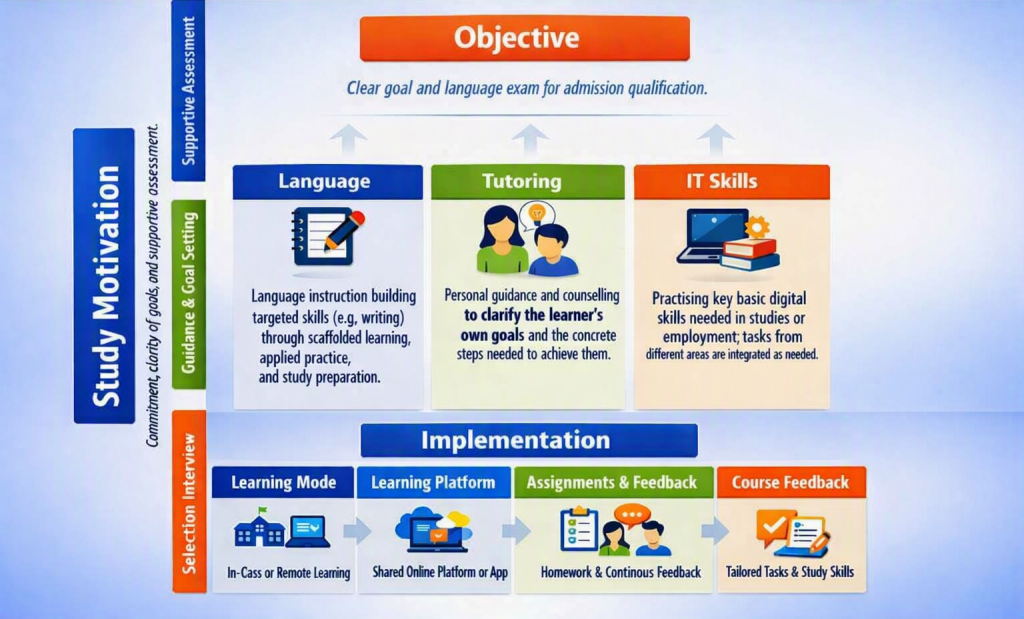
OBJECTIVE
The course objective must be well-defined and known to the participants. For example: preparing for a language test or further studies.
TARGET GROUP
Adult immigrants
- higher education graduates/ participants aiming for higher education
- others
COURSE CONTENT
- language instruction, which may focus on a specific area of language skills, such as writing, or on practising for a specific goal, such as a language exam
- personal counseling/tutoring, focusing on clarifying the learner’s own goals and the concrete steps needed to achieve them
- digital skills: practising key basic skills needed in studies or employment
- tasks from different areas are integrated with one another as needed
COURSE SCOPE AND SCHEDULE
The course should be kept relatively compact (e.g. 20–30 lessons), which helps participants maintain their motivation. A longer course can be divided into modules. Sessions should take place at least once a week, for a minimum of two lessons each time. The scope and intensity naturally depend greatly on the target group and the course objective. The schedule must be planned so that all learners selected for the course are able to attend every session. The attendance requirement should already be emphasised during the selection interview.
GROUP SIZE
- 10–20 people (recommended 12–15)
- It is important to keep the group size relatively small. Larger groups often show greater variation in language proficiency, leaving insufficient time for individual guidance.
LANGUAGE PROFICIENCY LEVEL
- Participants’ language proficiency must be at least level A2.
- For groups of higher education graduates and people aiming for higher education, level B1 is required, as this is the minimum prerequisite for further studies and employment.
- The group’s language proficiency level should be as homogeneous as possible. Excessive differences in level tend to reduce the motivation of all participants.
SELECTION PROCESS
Participants are selected through a personal interview. Initial screening is based on language proficiency level. In addition to language skills, the interview assesses the participant’s motivation, personal goals, and commitment to studying (including the attendance requirement). There is no flexibility in pre-decided criteria.
IMPLEMENTATION
- The training can be organized either as contact teaching or as remote learning. In both cases, regular attendance as well as regular, on-schedule submission of homework is required.
- Course materials are collected and homework is submitted on a shared learning platform, which may be either one used by the educational institution or a freely available, user-friendly application. Learners are guided in using the application. Alternatively, textbooks or other written materials accessible to all participants may be used.
- Course assignments consist of either ready-made or course-tailored materials. Homework is assigned regularly, and its completion or submission is monitored. In addition, tasks are carried out during lessons individually, in pairs, and in groups. Regular feedback is given on assignments. Assessment is continuous and supports learning.
- Tasks can be differentiated as needed. Some tasks may be mandatory, others optional. Learners are involved in selecting tasks whenever possible. The teacher provides feedback on all tasks. Peer feedback and self-assessment may also be used where appropriate.
- Attention is paid to the study skills required (which can vary considerably between countries) as well as to self-directedness.
- Oral and written feedback is collected from participants at the end of the course. This feedback is used in future planning.

Photo from Pixabay
ATTENTION TO STUDY MOTIVATION
- Participants’ study motivation is already addressed during the selection interview. Applicants are informed about the importance of commitment to studying (attendance, completing assignments), and the participant’s own goals are initially mapped.
- Through guidance sessions and materials, the aim is to help clarify the learner’s own goals, explore options together, and outline concrete steps toward achieving them.
- Continuous, supportive, and encouraging assessment (including self-assessment) is used to help improve participants’ study motivation.
PRICE
- The cost of training is often a critical issue for immigrant students and can become a barrier to participation.
- However, completely free training is not necessarily the best solution, as even a small financial investment can help strengthen commitment to the training.